
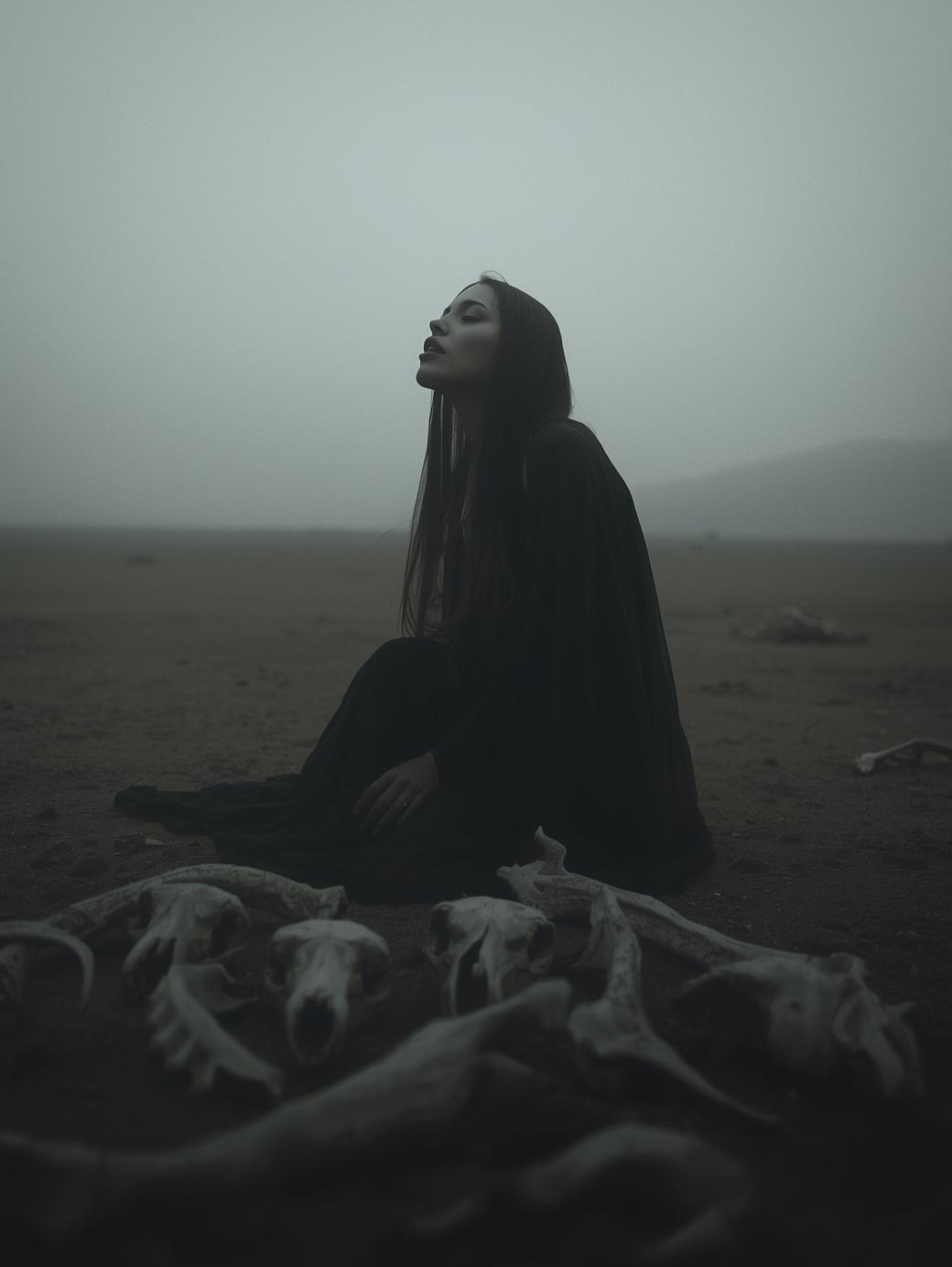
Deep in the hidden places of myth, in desert arroyos, forgotten caves, and the quiet spaces between life and death, walks a woman no one fully understands. She is called many names: La Loba, La Huesera, La Trapera, the Bone Woman, the Bone Collector. In the ancient stories that ripple through Northern Mexico and indigenous cultures of the Southwest, she is both feared and revered, not as a monster, but as a keeper of truth and transformation.
This is not a figure invented by modern storytellers, but one whose roots stretch into the soil of land and memory itself, a woman who gathers what the world has discarded and breathes life back into what was thought gone forever.
The Bone Collector, She Walks Among Bones
They say she lives where few dare to go, where the sun scorches stone and wind whispers of past lives. La Loba’s purpose is singular: she searches for bones. Not to desecrate, but to preserve the essence of what was once alive. Deer rib, rattlesnake vertebrae, crow talon, all end up in her cave of memory. But most of all, she seeks the bones of the wolf, the animal both feared and revered in the wildlands.

When at last, she has found and assembled an entire skeleton, the air falls silent. She stands over the white form, raises her arms, and begins to sing. And her song is not mourning, it is awakening.
As The Bone Collector’s voice coils over the dry earth, the bones begin to quiver, to stitch themselves together with sinew and muscle. Fur sprout from the ribs, eyes open in the skull’s dark sockets, and the creature breathes again. Then it runs, not away, but into its life reborn.
In some tellings, the wolf that rises eventually becomes woman again, a spirit of wilderness and freedom, laughing as she slips into night.
Bones as Memory and Magic
Bones are no mere leftovers. In many cultures, they are the last record of life’s fire, holding the blueprint of form and experience. The Bone Woman’s work is sacred. She collects what was lost so that it can be honored again.
Clarissa Pinkola Estés, in Women Who Run With the Wolves, echoes these stories not to invent them, but to reveal their psychological and spiritual power for modern women. The Bone Woman becomes a symbol of the inner crone and the psyche’s ability to reclaim what has been broken, forgotten, or abandoned.
Bones represent what remains when everything else has faded, the core self, the indestructible force of identity, memory, and spirit. The Bone Woman shows us that what was discarded can be woven back into life through song, attention, and ritual.

The Song of Becoming Alive
There is a ritual logic here, not of fear, but of resurrection and reclamation. Where death seems final, The Bone Collector’s song becomes a metaphor for healing. Her music is not agony; it is alchemy. Her song reconstructs flesh from dust, not to deny loss, but to transform it.
In myth after myth, from the wolf woman of the desert to the world of archetypes, singing over bones becomes a symbol of bringing what is buried into the light. In folklore worldwide, bones have voices: in Grimm’s tale “The Singing Bone,” a bone sings the truth of a crime when crafted into a horn.
This lesson recurs across culture, a whisper that the past is not lost or forgotten and that what was once silent can speak again.
She Is Not Alone in Legend
Though this post focuses on La Loba and her gathered bones, echoes of her work appear across the globe. Myths from Celtic and Scandinavian lands tell of women who craft body and spirit through song and ritual, weaving together what was lost. In Jewish, Papuan, Inuit, and African stories, bones become animated through the power of voice, flesh and memory integrated into life once more.
And while other mythic figures, like Aztec underworld beliefs where bones of the previous world are the source material for new life, differ in shape and setting, the undercurrent remains: bones are not just remnants, but seeds for new becoming.
What She Teaches Us

The Bone Collector teaches a paradox: that what has been shattered, uprooted, and forgotten can become the foundation of renewal. She teaches us to recognize:
- Loss is not emptiness, but a form of presence yearning to be heard.
- What you have discarded may be precisely what holds your strength.
- Grief and memory are not enemies; they are teachers in disguise.
Her song is a call to embrace what was thought lost, to gather the scattered fragments of self and stitch them into something that can walk, howl, and live again.
A Modern Incantation To The Bone Collector
To walk with the Bone Woman is to:
- Listen to the silences in your own life, the places you hide your pain, your fear, and your strength.
- Acknowledge the parts of yourself you have left behind.
- Sing; not with your voice alone, but with intention: breathe life into the broken, honor the forgotten.
- Understand that rebirth often comes from the bones of what once was.
The Bone Woman stands not as a harbinger of dread, but as a reminder that life, loss, memory, and magic are inseparably intertwined. When you walk among your own bones, the remnants of your past, and sing over them with reverence, you do not deny your history. You transform it into power.
La Loba does not wait for permission. She does not follow rules. She does not care what’s ‘meant to be.’ She takes what’s left , the remnants, the pain, the pieces and she creates again. If you want to learn how your ancestors might be whispering guidance in your own life, see 5 Powerful Signs Your Ancestors Are Trying to Guide You Right Now.”
Leave a Reply